You might find the same six products recommended in a different order wherever you look, described in much the same words. That is a fair reflection of the category — these tools genuinely do overlap — but it makes the choice harder than it needs to be.
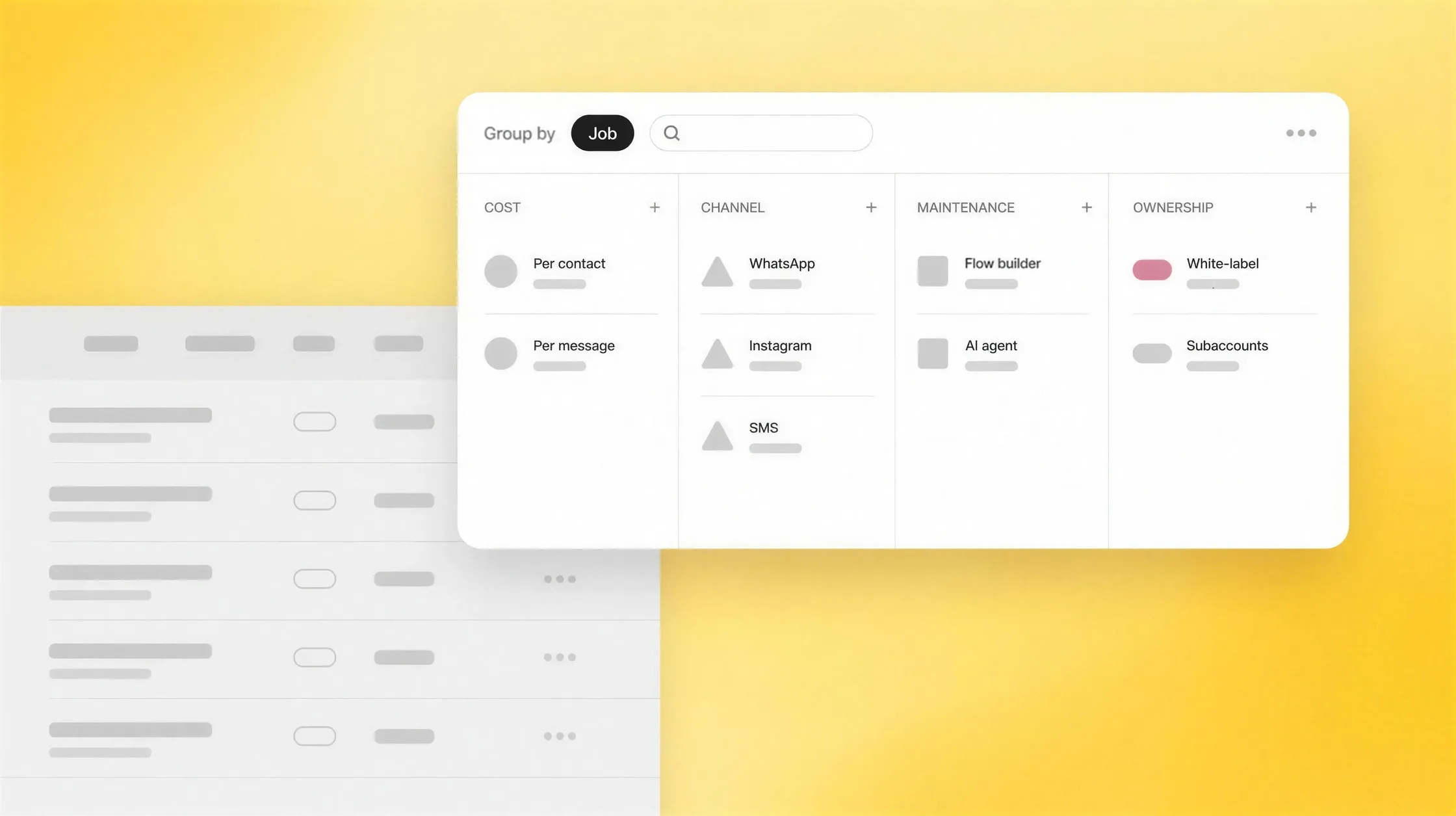
Sorting by job produces a much shorter answer, because the four problems that send people looking barely overlap at all.
If the bill is your problem, move to something that does not price per contact. If WhatsApp at volume is your problem, move to a platform built on Meta’s API. If maintaining flows is your problem, the mechanism is what needs replacing, not the vendor. And if you want to sell this to clients as your own, almost nothing here does that.
Start with which problem you have
The four are worth naming before any product is, because picking the wrong category is how people end up migrating twice.
- Cost shape. The bill grows with your audience and you cannot forecast it.
- Channel. You need WhatsApp at real volume, and it turns out that is a different kind of product.
- Maintenance. The flows work, but keeping them accurate has become somebody’s job.
- Ownership. You want to sell this to clients under your own name.
The rest of this sorts by those.
Per-contact pricing and what it costs at scale
This is the most common reason to start looking, and it is worth putting real numbers on rather than leaving as a feeling that the bill keeps climbing.
ManyChat charges by active contact, on five steps:
Scroll the table sideways
| Plan | Monthly | Annual | Included contacts | Channels |
|---|---|---|---|---|
| Free | $0 | $0 | 25 | 2 |
| Essential | $17 | $14 | 250 | 2 |
| Pro | $39 | $29 | 2,500 | 3 |
| Business | $99 | $69 | 7,500 | Unlimited |
| Advanced | $199 | $139 | 25,000 | Unlimited |
Annual figures are the monthly cost when billing yearly.
Going over a tier does not move you up a plan. You are billed per extra contact, and that rate changes at every step — which is where the model gets interesting.
Scroll the table sideways
| Plan | Per extra contact | Blended cost per included contact |
|---|---|---|
| Essential | $0.10 | $0.068 |
| Pro | $0.05 | $0.016 |
| Business | $0.025 | $0.013 |
| Advanced | $0.004 | $0.008 |
Blended cost is the plan price divided by its included contacts, at monthly billing.
Read the columns against each other. On Essential the extra contact costs about one and a half times the average contact already inside your plan. On Advanced it costs about half. Between the bottom and the top of the ladder the marginal rate moves twenty-five-fold.
So the model does not just get more expensive as you grow — it is hardest on the accounts least able to absorb it, and it eases exactly when you no longer need the help.
If this is your problem, the fix is a different billing unit, not a cheaper ladder. Chatfuel is the closest like-for-like: same Meta channels, but a flat $49 a month with unlimited active contacts, capping AI processing instead. Chatwoot prices per agent, which tracks your team size rather than your audience. Typebot prices per chat. There is a fuller side-by-side in ManyChat vs Chatfuel.
Instagram DM automation
Worth being honest here: on Instagram specifically, ManyChat is the more developed product, and cost is usually the reason to leave rather than capability.
Chatfuel covers the same channel and removes the contact meter. Beyond that pair, the field thins out quickly — most tools that market themselves for Instagram DMs are narrower, and the trade you are making is a smaller feature set for a flatter bill.
If Instagram is the whole job and your list is small, staying put is a legitimate answer. The ladder only bites above a few thousand contacts.
Open-source options
The reason to pick these is not price. It is control: you can host it yourself, see what it does with your data, and change it.
Chatwoot describes itself as an alternative to Intercom and Zendesk, which tells you what it is — a support inbox, not a marketing automation builder. It prices per agent at $19, $39 and $99 a month on annual billing, so the bill follows headcount rather than audience. One thing to check before planning around it: removing Chatwoot’s own branding is Enterprise-only, which puts a five-agent team at $495 a month before selling anything.
Typebot builds conversational forms and prices per chat — 2,000 for $39 a month, 10,000 for $89. It drops its branding from that first paid tier, unusually early. The catch for this particular use case is that WhatsApp only arrives on the $89 Pro tier, so the cheaper entry point does not include the channel most people come for.
Neither is a drop-in swap for ManyChat. Both are the right answer when hosting and modifying matter more than matching feature for feature, and the wrong one when nobody on the team wants to run infrastructure — self-hosting moves cost from an invoice to your own hours.
WhatsApp at real volume
This is the job where the category changes underneath you, and it is worth settling one fact first: WhatsApp always runs on Meta’s API, and Meta bills the messages separately from whatever the platform charges. No plan price you compare is the whole bill.
Meta charges per message delivered. Replying inside the 24-hour window a customer opens is free; opening a conversation yourself requires a template and costs money. That single asymmetry matters more to your invoice than the difference between two platform tiers.
Two platforms built around this:
- respond.io unifies WhatsApp, Instagram, Facebook and TikTok in one team inbox and prices on monthly active contacts — $99, $199 and $349 a month. Its WhatsApp fees are explicitly not included.
- Wati is WhatsApp-first, also prices on monthly active contacts, and also bills Meta’s charges on top. Worth knowing how its cap behaves: when you hit the contact ceiling, broadcasts keep running while operator replies, automations and AI responses pause until the limit resets.
Both are the right shape when a team needs to work the channel together. Neither changes the mechanism underneath, which is the next job.
When flow maintenance becomes the problem
This one shows up around month six and does not look like a pricing problem at all.
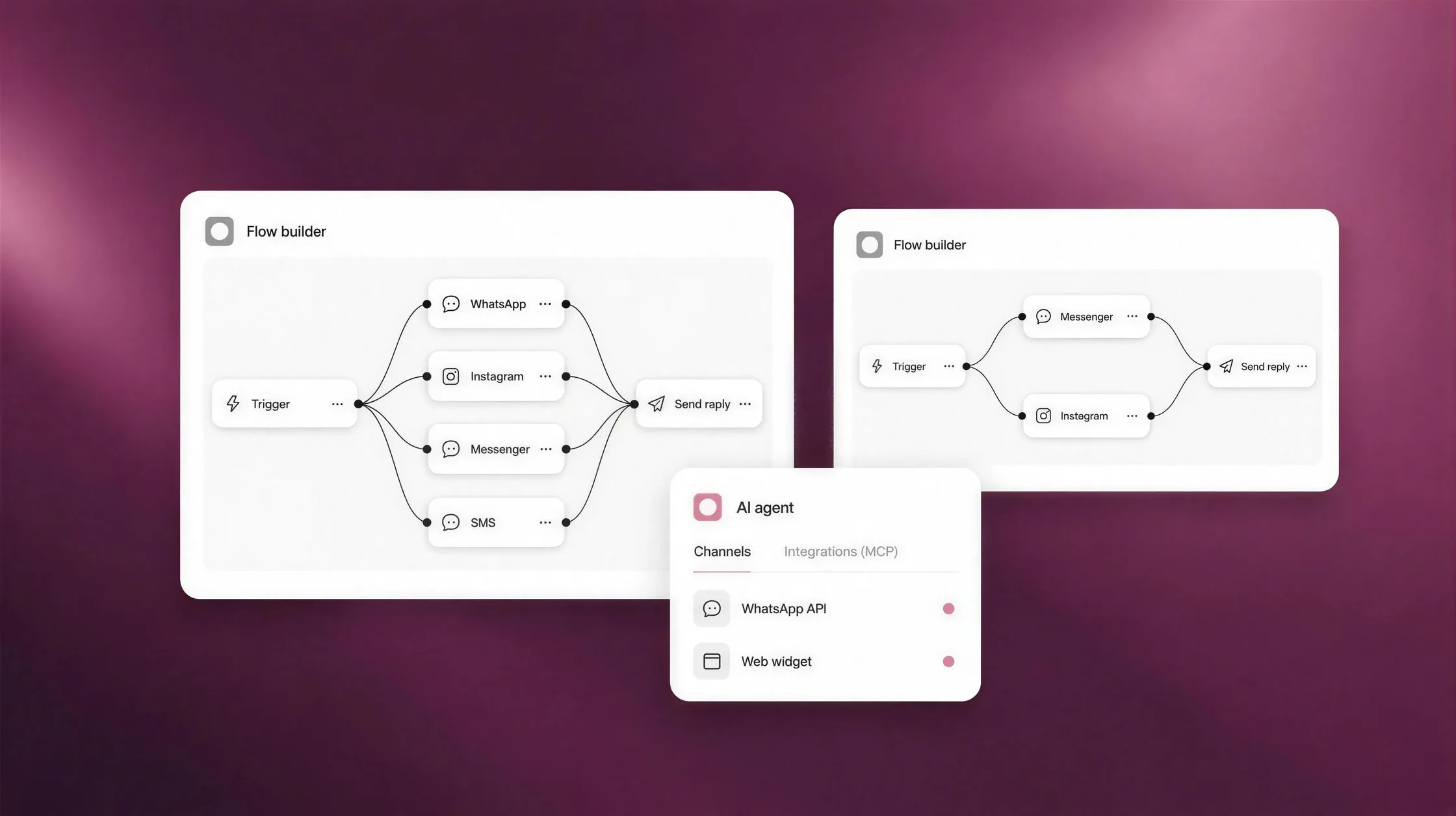
Both ManyChat and nearly everything above are flow builders. You draw a tree of triggers, conditions and replies, and the tree runs. It works while your customers ask what you anticipated. When they ask something adjacent — same intent, different words, one condition you did not think of — the flow guesses wrong or hands off.
Inside a flow builder, the fix is always another branch. The tree grows, and the cost that grows with it is not the subscription; it is the person who owns keeping it accurate.
Two things follow, and neither appears on a comparison table:
- Maintenance scales with variety, not volume. Ten thousand people asking three questions is easy. Three hundred asking eighty is not.
- Switching flow builders does not help. A faster way to add branches is not the same as not needing them.
The alternative is a different mechanism: a flow branches, an agent decides. Rather than matching an incoming message against a tree you drew, an agent reads what was asked, works out what to do, and reaches into your systems to do it. A question it has not seen before is an ordinary case instead of a fallback.
Alternatives you can resell under your own brand
This is the job where the field empties out, and being straight about that is the point.
Several platforms above let you remove their branding — ManyChat from $17, Typebot from $39, Chatwoot at Enterprise. That is a real feature and it is not reselling. Your client’s account is still their account with the vendor, there is no workspace under your name, and you have no way to bill them for it.
Reselling needs three things together:
- An isolated workspace per client, so one client’s data and configuration never touch another’s
- Your brand on what the client logs into, not just a badge removed from a widget
- Billing you control, so the client pays you and you set the margin
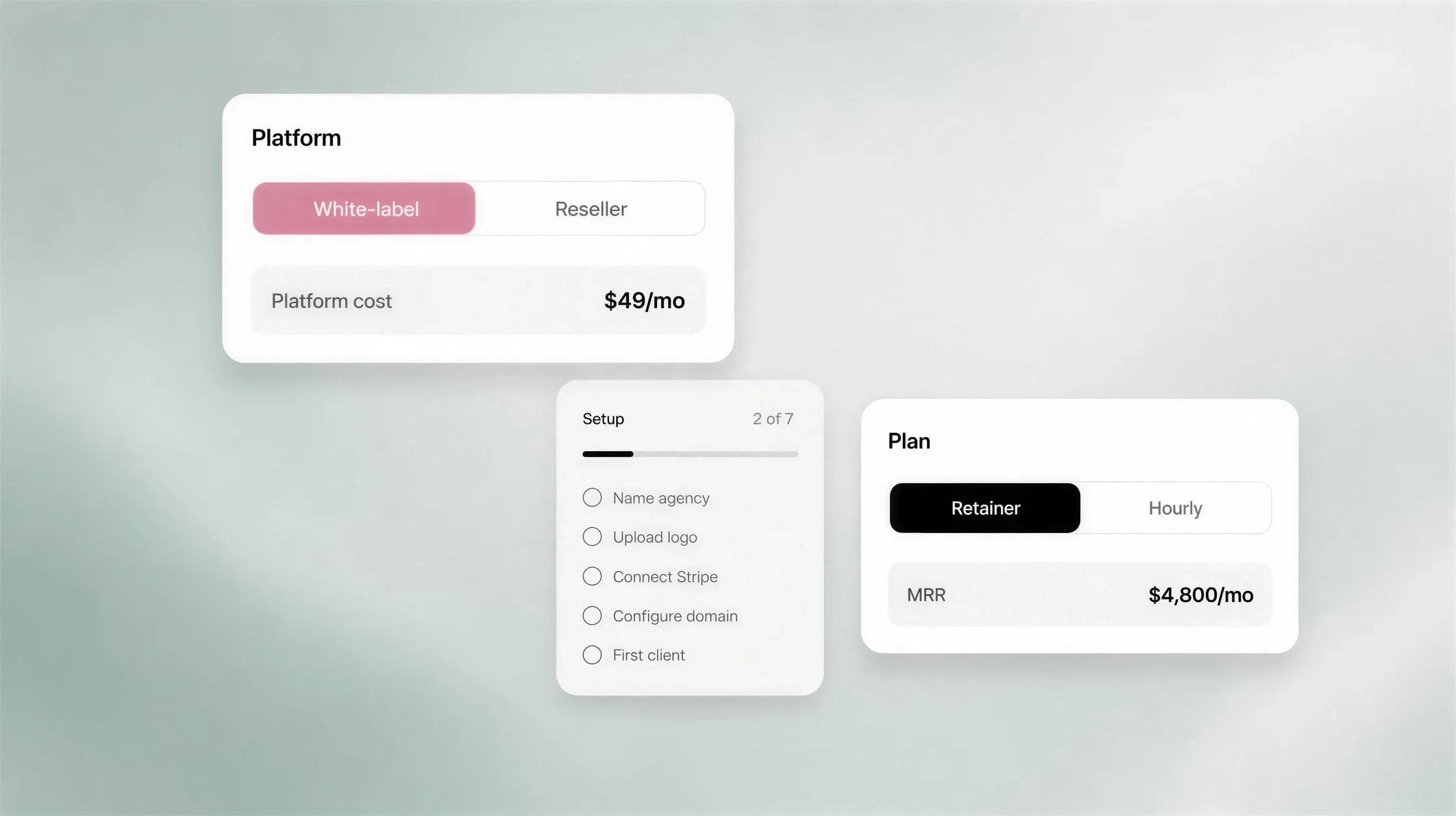
That combination is what Lety.ai’s white-label platform is for, and running it as your own product is what it looks like with clients attached. It is also the only one of the four jobs on this page where Lety.ai is the answer — for Instagram-first marketing automation on a small list, the tools above are a better fit, and saying otherwise would waste your time.
For agents to do more than produce text they have to reach the tools you already run — calendar, CRM, catalogue — which on Lety.ai is 900+ MCP integrations. Reaching them is what separates resolving a request from discussing it.
Picking one and migrating
Match the tool to the job you named at the start, then move in this order:
- Export your contacts before anything else. It is the asset that does not rebuild, and it is the one thing every platform on this page will let you take.
- Audit which flows actually fire. Most accounts carry a long tail of branches built once and never triggered. Porting them faithfully is how a two-day migration becomes a month.
- Rebuild the deterministic paths first. Confirmations, opt-ins, booking links — the ones where a fixed answer is the correct answer.
- Leave the open-ended questions for last, and use them to decide whether you needed a new platform or a new mechanism.
If one thing is worth taking from this: the reason you are looking is the thing to fix. A cheaper per-contact ladder still meters your audience. A different flow builder still needs branches. Choosing on that basis is what stops the next migration from being twelve months away.
Plan prices and billing units taken from each vendor’s official pricing pages in September 2026, and Meta’s charging model from its WhatsApp Business Platform documentation. These platforms revise tiers often: confirm current figures before projecting costs.