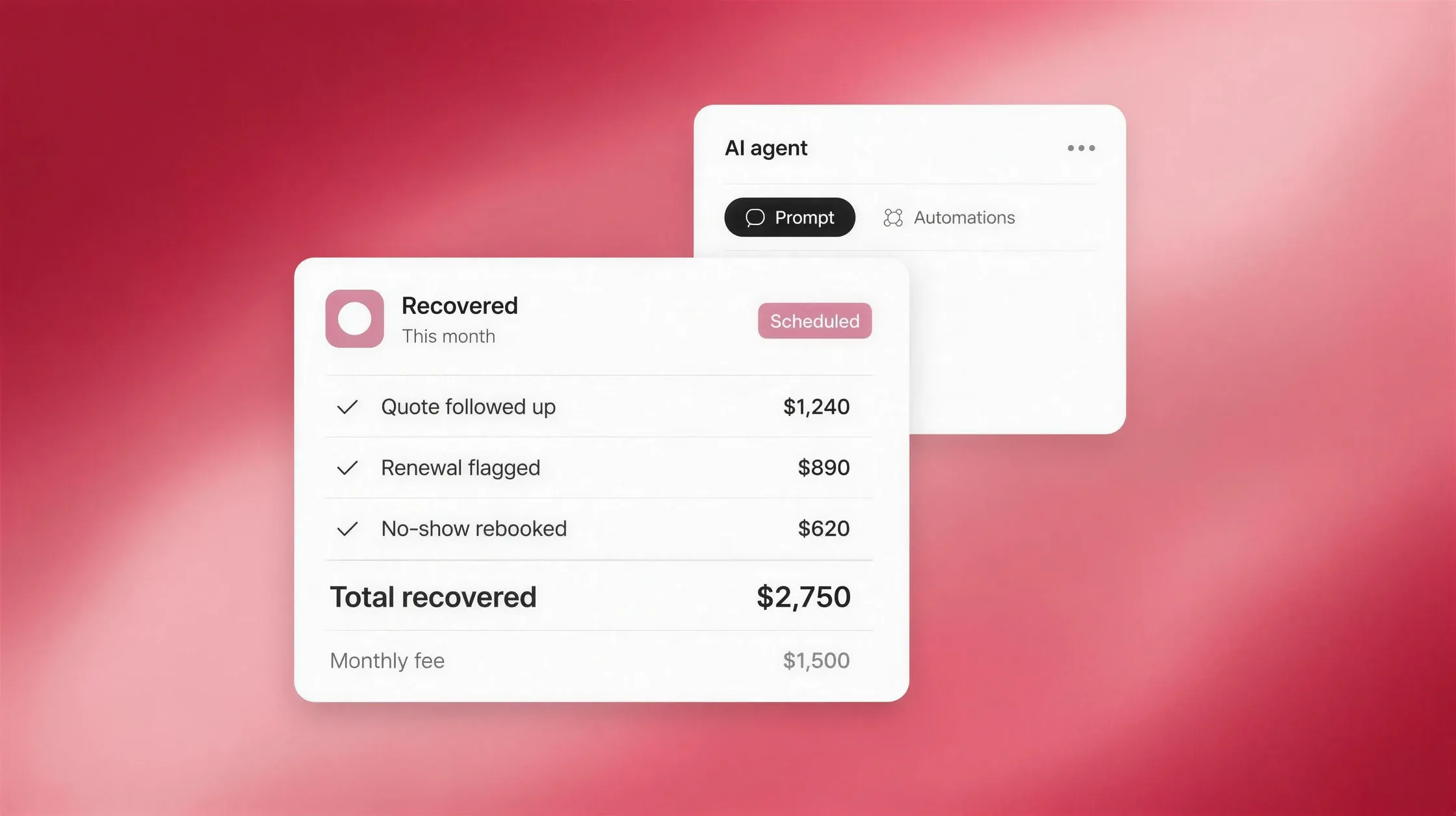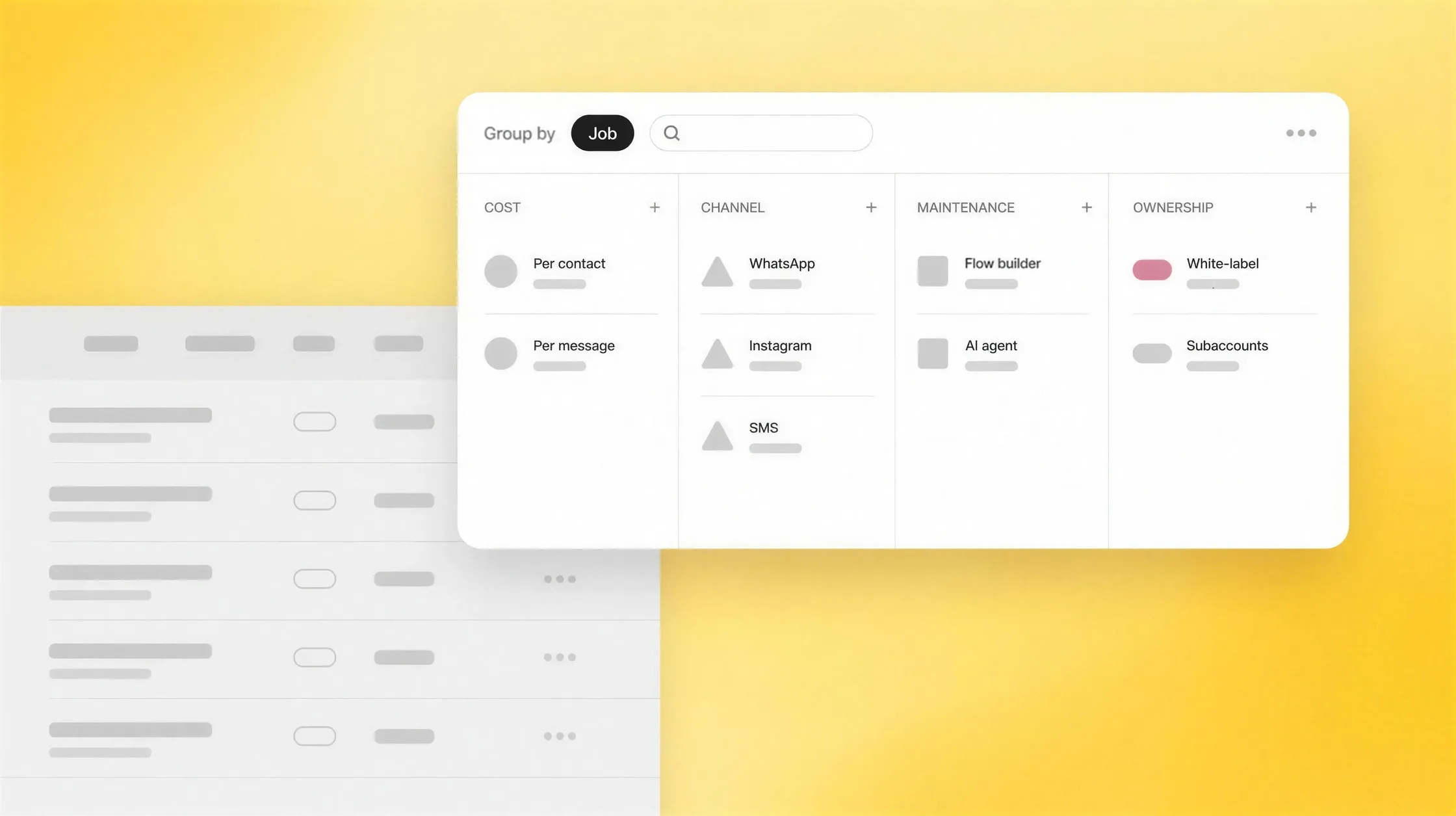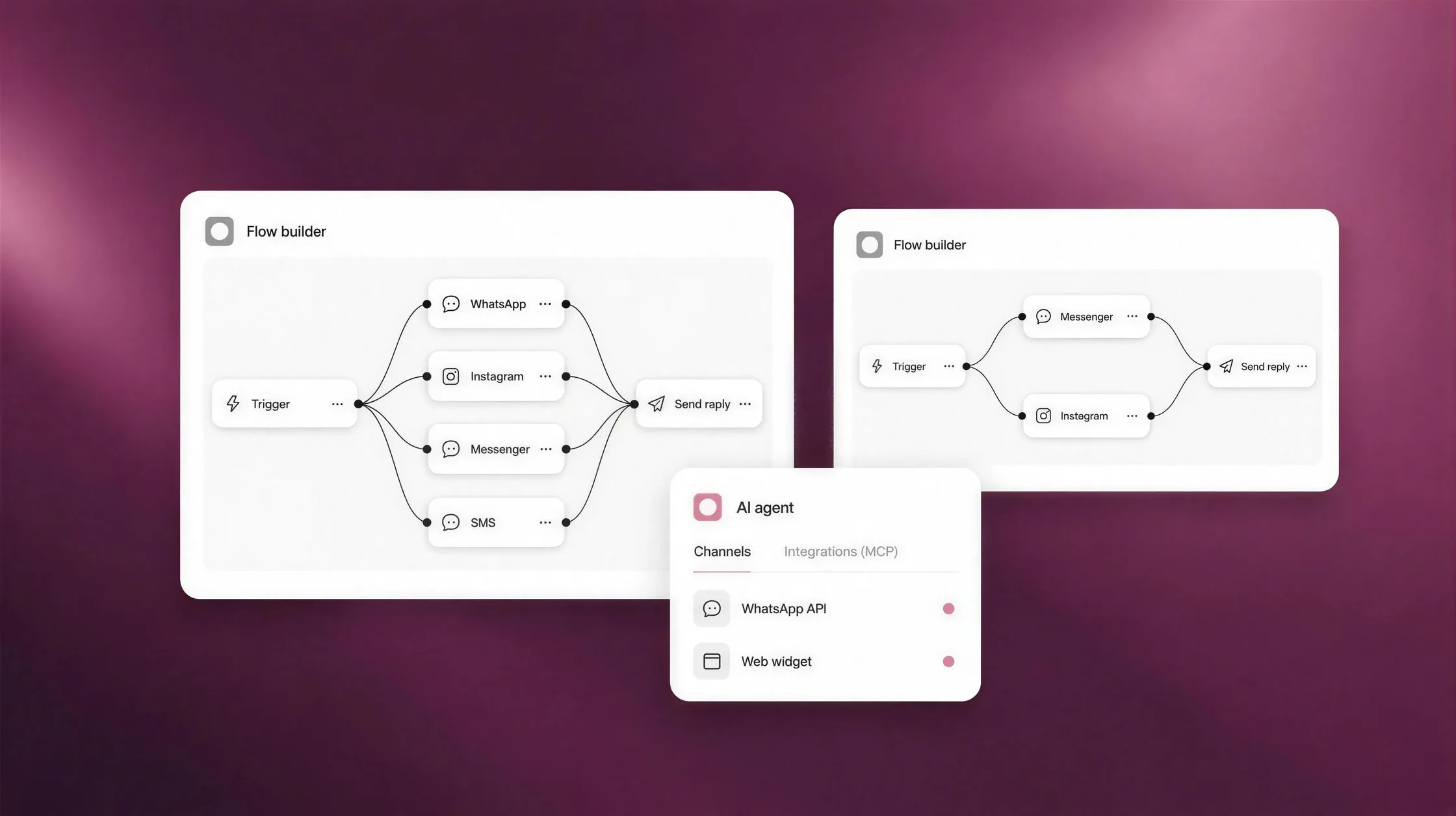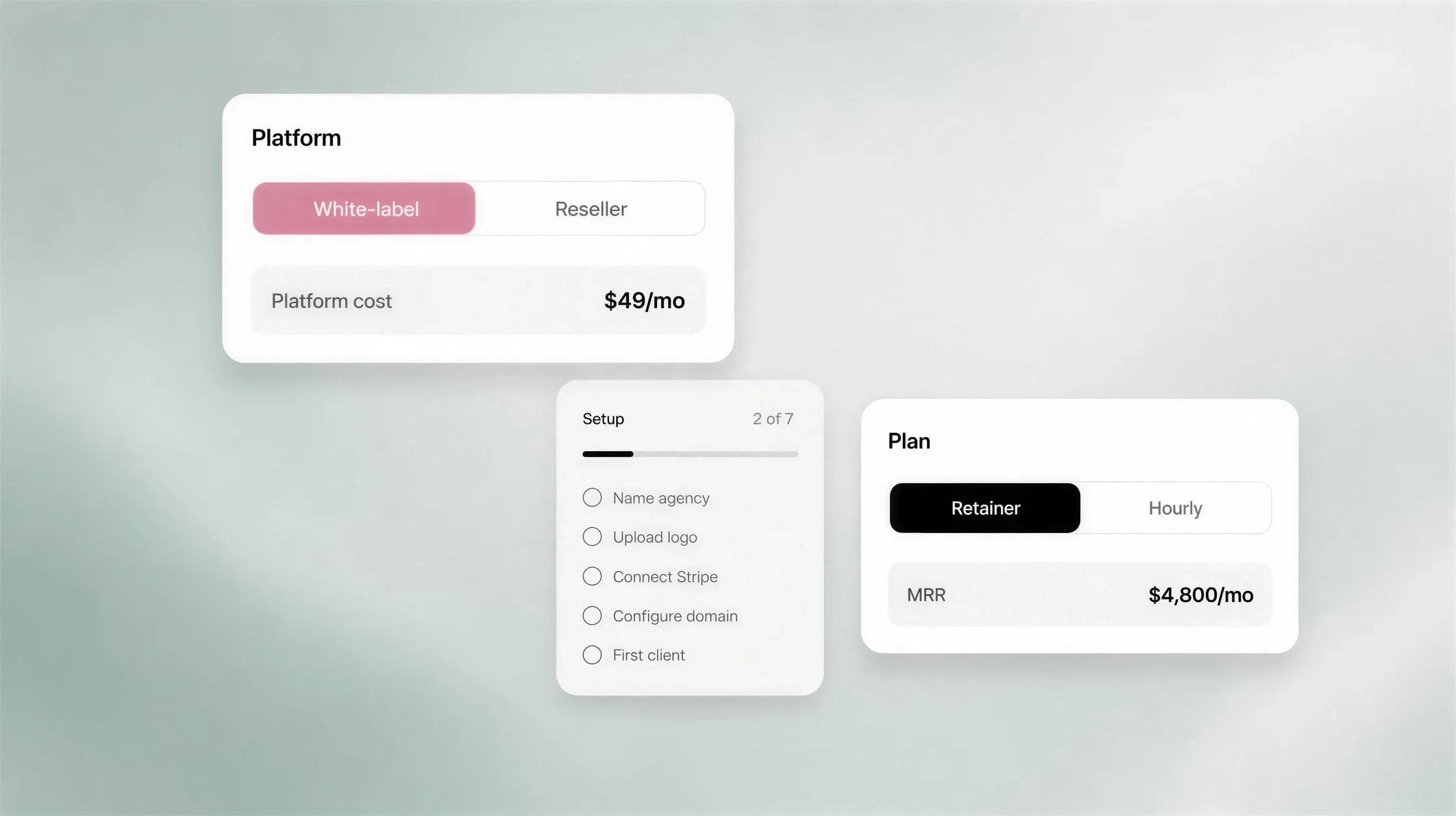
Starting an AI agency is mostly a sequence of ordinary decisions, and one of them decides whether the whole thing works: the money. Not the vision and not the tooling — what you charge, what the stack costs you, and what margin survives the difference.
So the money runs through every step below, in the order you actually face them.
Starting an AI agency comes down to two decisions: what you resell, and how you charge. The platform you pick sets your cost floor and your ceiling on what you can brand. The contract you write decides whether you built a business or bought yourself a job. Everything else is execution.
What an AI agency sells
Worth being precise, because the phrase covers two very different businesses.
The project business builds something and hands it over. A chatbot, an automation, an integration. You get paid once, the client owns the result, and next month you start from zero again. It is real work and it pays, but it is consulting with a different noun.
The subscription business runs something the client depends on. They pay every month because the agent is answering their customers every month. Your revenue compounds instead of resetting, and the asset you are building is the client base rather than the portfolio.
The second is what makes the numbers work, and almost every decision below is downstream of choosing it. If you only take one thing from this page, take that.
What it costs to start
Lower than most people fear, and structured differently than they expect. The largest recurring line is the platform, and the spread is wide because platforms mean different things by the same words.
Scroll the table sideways
| Platform | Entry price | Branding starts at | What carries your brand |
|---|---|---|---|
| Lety.ai | See pricing | The entry tier | Isolated client workspaces, your domain, your billing |
| Stammer.ai | $197 / mo | Agency, $197 | Domain, client sub-accounts, billing |
| CustomGPT.ai | $99 / mo | Premium, $499 / mo | The chat experience, not a client panel |
| Botpress | Free | Plus, $150 / mo annual | The chat widget only |
| Vendasta | $99 / mo minimum | Professional, $499 / mo minimum | Client portal |
Entry price is the lowest paid tier; branding is the tier where your name appears.
Three things that table cannot hold, and each one changes the maths:
The entry price is rarely the price you pay. Vendasta’s entry tier is literally named “Co-branding with Vendasta” — their brand stays visible to your client. Several platforms separate the branding you can use from the branding you can sell, and only the second one is a business. Ask which tier you are being quoted.
Some minimums are commitments, not fees. Vendasta’s $499 is a minimum in wholesale product spend on a one-year contract. That is a switching cost, not a monthly subscription, and it should be priced as such before signing.
“White-label” describes at least three products. Botpress white-labels the chat widget — your client sees an unbranded box but never gets a dashboard. CustomGPT.ai covers the whole chat experience under your domain but gives no client panel. Stammer.ai includes sub-accounts and billing at its entry tier. Ask which one you are buying.
Beyond the platform, the real costs are unglamorous: a company registration, a domain and site, and the months of subscription you pay before the first client signs. Budget for that gap.
Picking a niche
Pick the one where you can already name three specific processes that waste somebody’s time. Not the largest market — the one whose language you speak.
This matters more than it sounds, because your first five clients will not come from a market being big. They come from someone believing you understand their work, and that belief is built in a fifteen-minute conversation where you name their problem before they finish describing it.
Two practical filters:
- Repetitive, high-volume conversations. If the same twenty questions arrive every day, an agent has obvious value and the ROI conversation is short.
- A budget that already exists. Someone already paying a person, an answering service, or another tool to handle this. New budget is a much harder sell than redirected budget.
If you have no sector history to draw on, the practical constraint is that designing an agent for an unfamiliar industry and learning to sell it are two jobs at once. Look for a platform that shortens the first one — on Lety.ai, an AI assistant walks you through configuring the agent, so the work is answering questions about the business rather than building the thing from a blank page.
Build, resell, or both
This is decision one of the two, and it sets everything downstream.
Building means your own stack, your own infrastructure, full control and full responsibility. It needs development capacity and it needs it permanently, because the maintenance never ends.
Reselling means someone else’s platform under your name. You trade some control for speed and for a cost you can predict per client. Your product ships in weeks rather than quarters.
Both is where most working agencies land: resell the platform, build the integrations and the domain expertise that make it fit a specific industry. The platform is the commodity; what you know about the niche is not.
The question that decides it is not technical. It is whether you want to sell your capacity or sell a product. Building sells capacity for as long as you keep building. Reselling sells the same thing many times.
Where the money actually comes from
How an AI agency makes money is a big enough question to deserve its own treatment — the models, the margins, the niches with the most room in them. The short version is that the durable version of this business charges a setup fee plus a monthly subscription, and takes its margin on the spread between what the platform costs per client and what the client pays.
The AI agency page covers the structure in more depth, including how niche choice interacts with what you can charge.
Pricing before you build
The most expensive mistake here is quoting before you know your own floor.
Your floor is what the platform costs you per client, plus whatever usage the client generates. Everything above that is margin, and margin is what you are actually selling. A quote made without that number is a guess.
Three structures, and only one of them compounds:
- Hourly. You are a freelancer with better tooling. Your income has a hard ceiling equal to your waking hours.
- Flat project fee. Better, but every delivery returns you to zero and the next month starts with an empty pipeline.
- Setup fee plus monthly subscription. The setup fee covers your delivery time so you are not financing the client’s launch. The subscription is the business.
Price the outcome the client gets — calls answered, leads qualified, bookings taken — rather than the hours you spent or the technology you used. Nobody is buying an AI agent at the core. They are buying not missing enquiries at 9pm.
Shipping the first agent
Ship narrow. One process, working properly, beats five half-configured.
The sequence that works: pick the single highest-volume conversation the client has, automate it end to end including whatever system it has to touch, and let them watch it run for two weeks before you add anything else.
That last part is the one people skip. The two weeks are not caution, they are evidence — and evidence is what you sell the second client with.
What makes an agent worth paying for is rarely the conversation quality. It is whether it can reach the systems that make an answer real: the calendar, the CRM, the catalogue, the ticketing system. An agent that answers beautifully and cannot book anything is a demo. That reach is why integration depth deserves more of your attention than conversational polish when you compare platforms — 900+ MCP integrations on Lety.ai exist for exactly this reason.
Where clients actually come from
Not from ads, at the start. From three places, in this order:
People who already know you. Former colleagues, former clients, your own network. They are not a lucky shortcut — they are the only group that will buy from an agency with no case studies, because they are buying you.
Communities where your niche talks. Not agency communities, where everyone is a competitor. The forums, groups and events where the industry you picked complains about its own problems. Be useful there for a while before you sell anything.
Referrals from the first result. Once one recognisable business in a niche is running your agent, everyone else in that niche is a warm conversation. This is the compounding effect, and it is the reason niche focus beats breadth early.
Finding the first five
The first five clients are a different problem from client six onward, and they are worth treating as such.
- Aim for one lighthouse. A single recognisable name in the niche is worth more than three anonymous ones, because the next twenty conversations start with it.
- Trade price for proof. Discounting the setup fee to get a case study is a reasonable trade. Discounting the subscription is not — that is the number you should always defend.
- Sell the pilot, not the platform. A four-week paid pilot on one process is an easy yes. A twelve-month contract from an agency with no history is not.
- Ask for the referral at the result, not at the invoice. The moment to ask is when the client first sees the thing working, which is rarely when you send the bill.
Expect a low conversion rate and a long first cycle. It compresses fast once you have something to point at.
Making the revenue recurring
This is decision two, and it is a contract-design question, not a timeline.
Revenue is recurring from the first client if you structured it that way, and never if you did not. There is no month at which project work turns into subscriptions on its own.
What makes the subscription defensible is that the client depends on the agent operationally. The agent answers their customers; turning it off is a visible downgrade in their business. That dependency is worth more than any contract clause.
The mechanics matter here more than they appear to:
- The client pays you, not the platform. If they hold the subscription, they are the platform’s customer and you are a consultant they can drop.
- You set the margin. Your price to the client and your cost per client are two different numbers you control independently.
- One invoice, from you. A client who receives two bills understands they are paying a vendor plus a middleman.
That combination is what our white-label platform is for: isolated workspaces per client, your brand on what they log into, and billing through Stripe Connect that goes out under your name. There is no revenue share on the subscriptions you charge — the only platform fee on what you collect is a transaction fee in the 1.9–4.9% range, and the rate drops as you move up tiers. Current tier ranges are on the pricing page.
What breaks in month three
Predictable, and worth pre-empting.
Scope creep on the first client. The agent works, so they ask for one more thing, then another, none of it in the contract. Fix it by defining what the subscription covers and what is a new setup fee, in writing, before it happens.
Maintenance eating delivery time. Every agent you ship is something you now maintain. If your fifth client’s build is delayed by your first client’s tweaks, you have discovered that your capacity, not your pipeline, is the constraint.
Discovering the platform’s ceiling. Something a client needs turns out to be impossible on the stack you chose. This is the one that hurts, because migrating clients is far harder than choosing correctly in month zero. It is the argument for reading integration lists before pricing pages.
Cash-flow lag. Setup fees arrive at delivery, subscriptions accumulate slowly, and the platform bills you monthly from day one. The gap is at its widest exactly when you are busiest.
Your first thirty days
Concrete, in order:
- Days 1–5. Pick the niche and write down three processes in it that waste time. If you cannot name three specifically, pick a different niche.
- Days 6–10. Choose the platform. Compare on what carries your brand and what it can integrate with, then on price. Confirm you are buying the tier that lets you sell, not just the one that removes a logo.
- Days 11–15. Build one agent for the process you understand best. Use yourself as the client. This is your demo and your proof you can actually deliver.
- Days 16–25. Talk to ten people in the niche. Not a pitch — ask what takes their time. Your offer will be sharper after ten of these than after any amount of planning.
- Days 26–30. Make one paid pilot offer, priced as setup plus monthly. Not free, not a discount on the subscription. Get one yes.
Thirty days does not get you an agency. It gets you two things: the two decisions settled, and one real conversation with a buyer.
Those decisions are worth restating here, because everything above sits on top of them and they are easy to lose along the way.
Decision one: what you resell. Build, resell, or both — settled on days 6 to 10, when you choose the platform. It sets your cost floor and your ceiling on what can carry your name, and it decides what you can integrate with, which is what you can actually promise a client. Change it later and you are migrating every client you have.
Decision two: how you charge. Settled before you build anything. A setup fee plus a monthly subscription compounds; an hourly rate or a one-off project fee resets to zero the moment you deliver, and no amount of good execution fixes that.
Neither is technical, and both are made before you configure a single agent. That is why they come first rather than getting discovered in month three.
Platform pricing and branding terms taken from each vendor’s official pricing pages, verified August 2026. These platforms revise tiers often, and several distinguish between branding you can use and branding you can sell: confirm current terms before committing.