If you are looking at alternatives to Wati, the first thing worth settling is what you are actually replacing.
Wati is not the WhatsApp Business API. The API belongs to Meta, and Meta charges for the messages no matter whose platform sits in front of it. What Wati sells is the software around that channel — a team inbox, chatbots, broadcasts, AI agents — and it charges a subscription for that on top of what Meta already charges you.
You might find Wati alternatives lined up in a feature table, but it is worth settling the layer question first, because two products sitting on the same table can be solving completely different problems — and the one that looks cheaper there can be the expensive one once the messages start flowing.
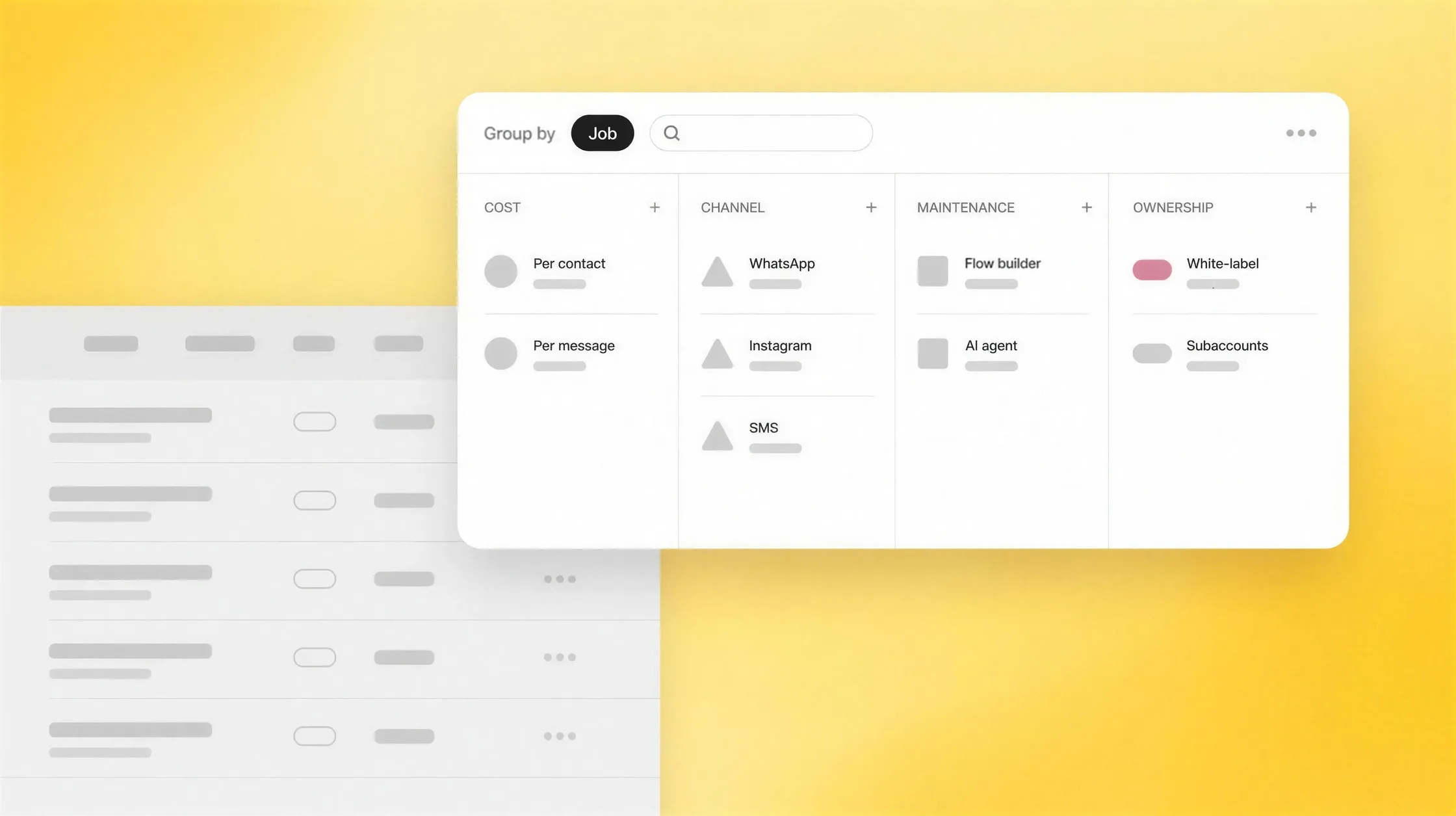
So the options split into three groups, and picking well means knowing which group you are shopping in.
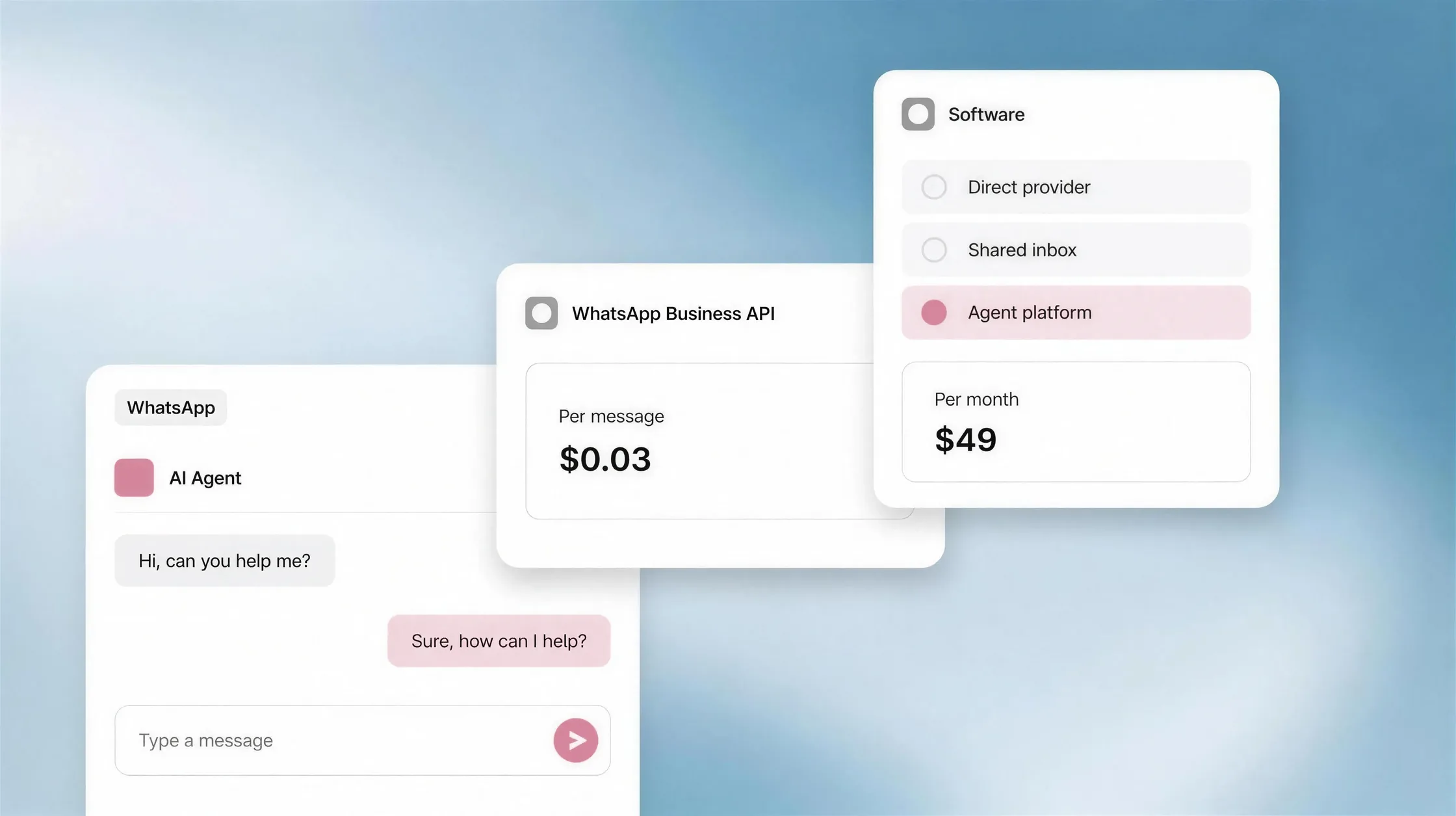
Your WhatsApp bill has two halves: what Meta charges per message, which nobody can discount, and what the platform charges on top, which is the only half you control.
What Wati is, and what sits underneath it
Underneath Wati is the WhatsApp Business API. It has no screen and no inbox — it is a connection that lets a program send and receive WhatsApp messages on a company’s behalf. Everything a user sees comes from software layered above it.
Wati is one of those layers. Its own pricing page is explicit that template message charges apply in addition to the plan, and that per-message rates vary by category and destination country. Two bills, not one.
That is not a criticism of Wati specifically. Nearly every platform in this category works the same way, and the ones that pretend otherwise are usually rolling Meta’s cost into a bundle where you can no longer see it. What matters is knowing the structure, because it is what makes the alternatives comparable at all.
For the full mechanics of how Meta charges — the categories, the windows, the exceptions — there is a separate breakdown of the WhatsApp Business API. The short version is below, because you cannot evaluate a single alternative without it.
Where your WhatsApp bill comes from
Since 1 July 2025 Meta charges per message delivered, not per conversation. The old conversation-based model is deprecated, which means that if a comparison content still mentions it, it is pricing a scheme that no longer exists.
What that changes in practice:
- You are charged when a template message is delivered — not when you send it.
- Marketing templates are always charged.
- Utility and authentication templates are free inside an open service window, and charged outside it.
- Messages that are not templates are free inside that window.
The customer service window opens when a customer writes to you and lasts 24 hours. Inside it you reply freely at no cost. Outside it you can only open with a template, and that template is charged. There is one more exception worth knowing: when the conversation starts from a click-to-WhatsApp ad or a Facebook page button, every message is free for 72 hours.
Meta charges no platform fee at all for API access. There is no licence and no monthly minimum for the channel itself.
Put those two facts together and the whole comparison reframes. Replying is free. Opening costs money. And the platform fee is the part of the bill that varies by vendor. A business that mostly answers inbound messages can have a near-zero message bill and still be paying hundreds a month for the software doing the answering.
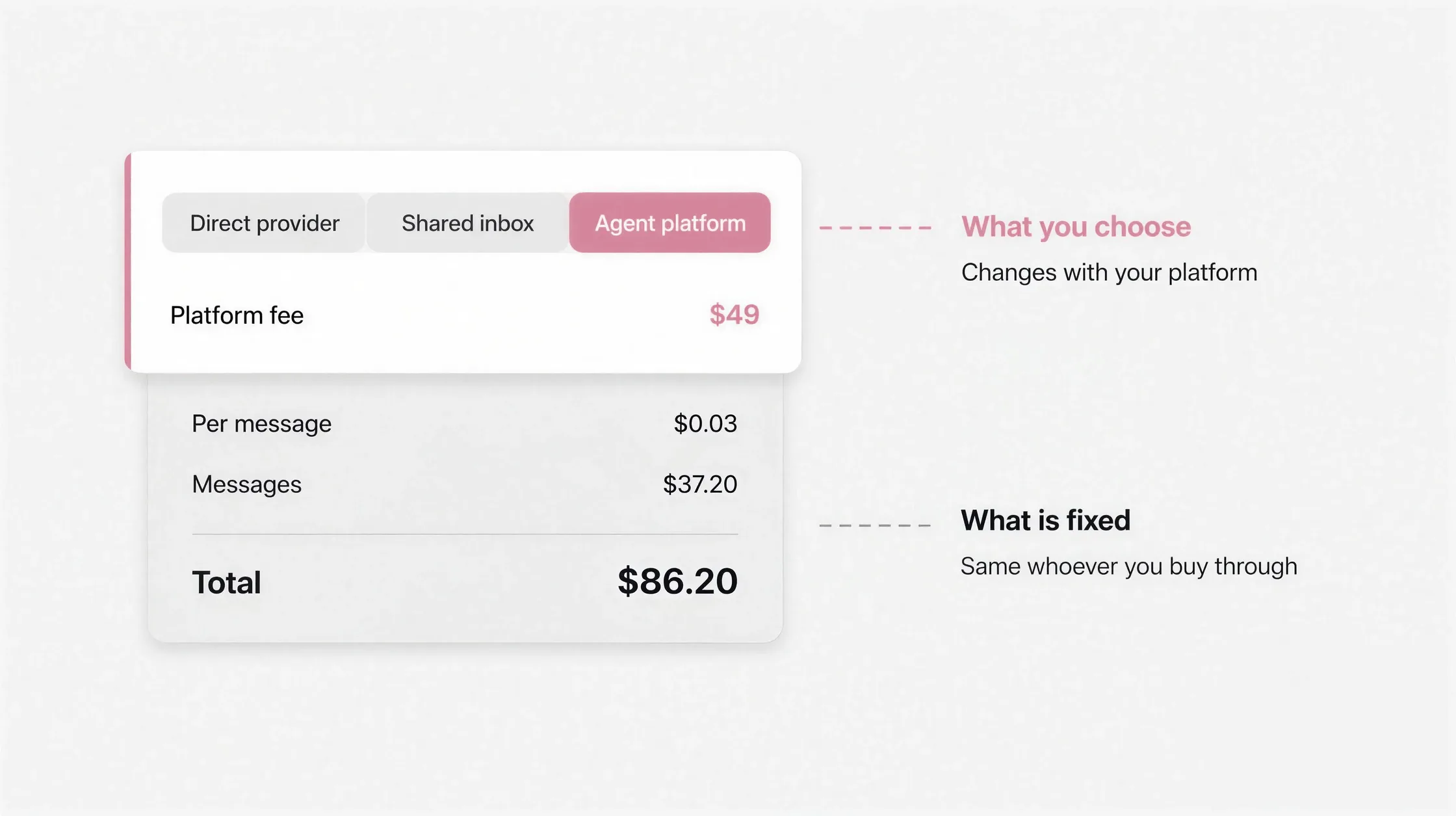
The two halves of a WhatsApp bill: Meta’s per-message charge, identical whoever you buy through, and the platform fee on top, which is the half that changes by vendor.
Why teams look for something else
Four reasons come up repeatedly, and only one of them is about features.
The billing unit stops matching the business. Wati prices on Monthly Active Contacts, and its definition is worth reading closely: a MAC is any contact with a real two-way interaction during the billing month. A contact who only receives a one-way broadcast does not count, and a contact sitting in your list without interacting does not either.
That definition has a sharp edge. When you hit the MAC ceiling, broadcasts keep running but operator replies, automations and AI agent responses pause until the next month or until you upgrade. The side of your operation that costs Meta money keeps flowing; the side that is free inside the service window is the side that stops.
The seat model gets expensive as the team grows. Additional users run $24 a month on Pro and $69 a month on Business, on top of the MAC ceiling and on top of Meta’s charges.
The price you see is not quoted in one currency. Wati’s pricing page localises — the same URL returns pesos, rupees or dollars depending on where you load it from. You might find a single dollar figure quoted for Wati somewhere, but it is worth checking against what the page shows in your own market, because that figure is a conversion of whichever currency the writer happened to be served.
The platform answers with flows, and the questions stop fitting. This is the one that shows up around month three rather than on day one, and it is the reason the third group below exists.
Direct providers
For a certain kind of buyer this is the cheapest answer by a wide margin, and it is the group most easily overlooked because it does not compete on the same terms as the rest.
A direct provider sells you the channel, not the software. You get API access and you put your own tooling on top.
360dialog is the clearest example. Access runs €49 per number per month on its regular tier (approximately $57), €99 on Premium (approximately $115) and €249 on Advanced (approximately $289), always plus Meta’s fees. The part that matters is what it promises about those fees: no markup on Meta’s rates. What Meta charges is what you pay, with the provider’s fee sitting visibly beside it rather than folded inside it. Its partner programme starts at €250 a month (approximately $290) plus €49 per channel, and it exists for agencies managing WhatsApp accounts across many clients.
The verdict on this group: excellent if you have development capacity and want to see exactly where every euro goes, and the wrong choice if you were hoping to buy an inbox. Nobody here is giving you a place for your team to answer messages.
You can also skip the middleman entirely. Meta says plainly that a business building for its own use can go direct. The filter is not infrastructure — the on-premises version was shut down in October 2025 and there are no servers to run — it is whether you have someone who can code the connection.
Shared-inbox platforms
The group Wati belongs to. You get a place for a team to work: assignment, labels, routing, broadcasts, reporting.
respond.io is the closest structural comparison. It unifies WhatsApp, TikTok, Instagram and Facebook in one team inbox, and prices on monthly active contacts the same way Wati does: $99 a month on Starter, $199 on Growth and $349 on Advanced. It is equally explicit that WhatsApp fees are not included and that Meta bills them on usage.
One detail worth reading carefully on that page. You might find the figures $79, $159 and $279 quoted as its prices, but those are the monthly cost of an annual plan, not the monthly rate. The gap between the two columns is the commitment discount, around 20%, and reading the wrong one understates what a month-to-month plan costs you.
The verdict on this group: right when the bottleneck is people coordinating, and the wrong shape when the bottleneck is volume of repetitive questions. Adding seats to an inbox scales the cost of answering, not the capacity to answer.
There is a regional bias to be aware of while shopping here. Most of the platforms in this field are built for and marketed to the Indian market, which shows up in pricing, in supported payment rails and in what the support hours look like from the Americas. If you are operating in the Americas, that is worth checking before the trial ends rather than after.
Agent platforms on top of the API
The third group changes the mechanism rather than the vendor.
A shared inbox assumes a person will answer. A flow builder assumes you can anticipate the question. An agent assumes neither: it reads what was asked, decides what to do, and reaches into your systems to do it.
There is an economic angle here that a feature table has no column for. Because replying inside the 24-hour window is free and opening costs money, automating the reply is worth more than automating the send. Answering common questions, qualifying whoever writes in, booking, reporting order status — all of it happens inside a window the customer already opened, which means all of it is free on Meta’s side.
This is where Lety.ai sits. Not as a provider of the channel — the channel stays Meta’s, and you can bring whichever route you prefer — but as the layer that decides what gets answered and what happens next. For an agent to do more than produce text it has to reach your calendar, your CRM and your catalogue, and that reach is what separates resolving a question from merely discussing it. On Lety.ai that layer is 900+ MCP integrations.
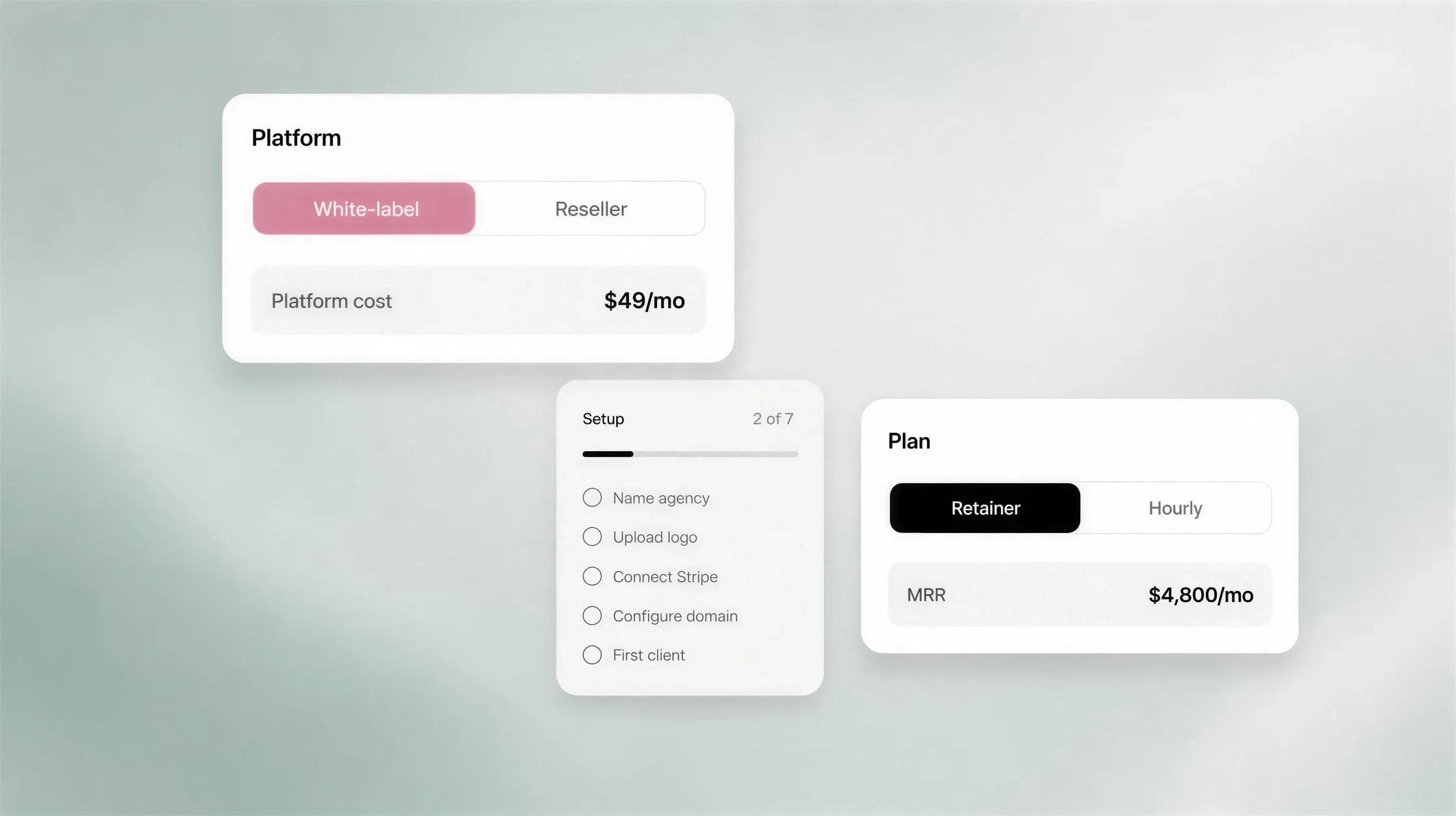
For agencies the difference goes further, because a client account and a reseller account are not the same product. Selling WhatsApp automation under your own name needs three things that removing a logo does not give you: an isolated workspace per client, your own brand on what the client logs into, and a way to bill them. That is what the white-label platform covers, and what running it as your own product looks like in practice.
The US and LATAM angle worth checking
Much of what is written about this category comes from and is written for India, where a large part of this market lives. It is worth knowing because a buyer in Miami, Mexico City or Bogotá is reading recommendations tuned to a different set of constraints: different payment rails, different support hours, different assumptions about which channels matter.
Two things change for a business operating across the Americas. Support that overlaps your working day stops being a footnote when a broadcast misfires on a Tuesday morning. And the person on the other end being able to work in your language matters more in this category than in most, because configuring message templates is fussy, high-consequence work.
Lety.ai is headquartered in Miami with an office in Medellín, and the team works from points across the Americas — which is a deliberate answer to that gap rather than a coincidence of hiring.
How to switch without repricing twice
The mistake that costs the most is switching platforms before understanding your own message mix — because the platform is the half of the bill you control, and you cannot tell whether you are overpaying until you know what the other half looks like.
So, in order:
- Measure a week of real traffic. How many conversations does the customer open, and how many do you have to open? That single ratio decides almost everything, because inbound conversations are nearly free to answer and outbound ones are not.
- Decide the route before the software. Direct to Meta, or through a provider. Those are different decisions with different costs, and bundling them is how people end up unable to explain their own invoice.
- Price the unit you actually consume. Active contacts, agents and numbers are three different meters. The cheapest headline price on the wrong meter is not cheap.
- Check what you can resell before you promise it to a client. Branding removal, isolated workspaces and client billing are three separate capabilities, and most platforms give you one of the three.
Then, and only then, move.
If you take one thing from all of this, make it the ratio in step one. A business whose customers open most of the conversations is paying almost nothing to Meta and should be optimising the software layer hard. A business that has to open them is paying Meta in templates, and no change of platform will fix that — only a better reason for customers to write first.
Provider pricing and Meta’s charging model taken from each vendor’s official documentation in September 2026. Euro amounts converted at the European Central Bank reference rate of 1 September 2026 and rounded; the billed amount follows the rate on the day. Rates change often, and Wati’s pricing page is served in the currency of your country: confirm current figures for your own market before projecting costs.