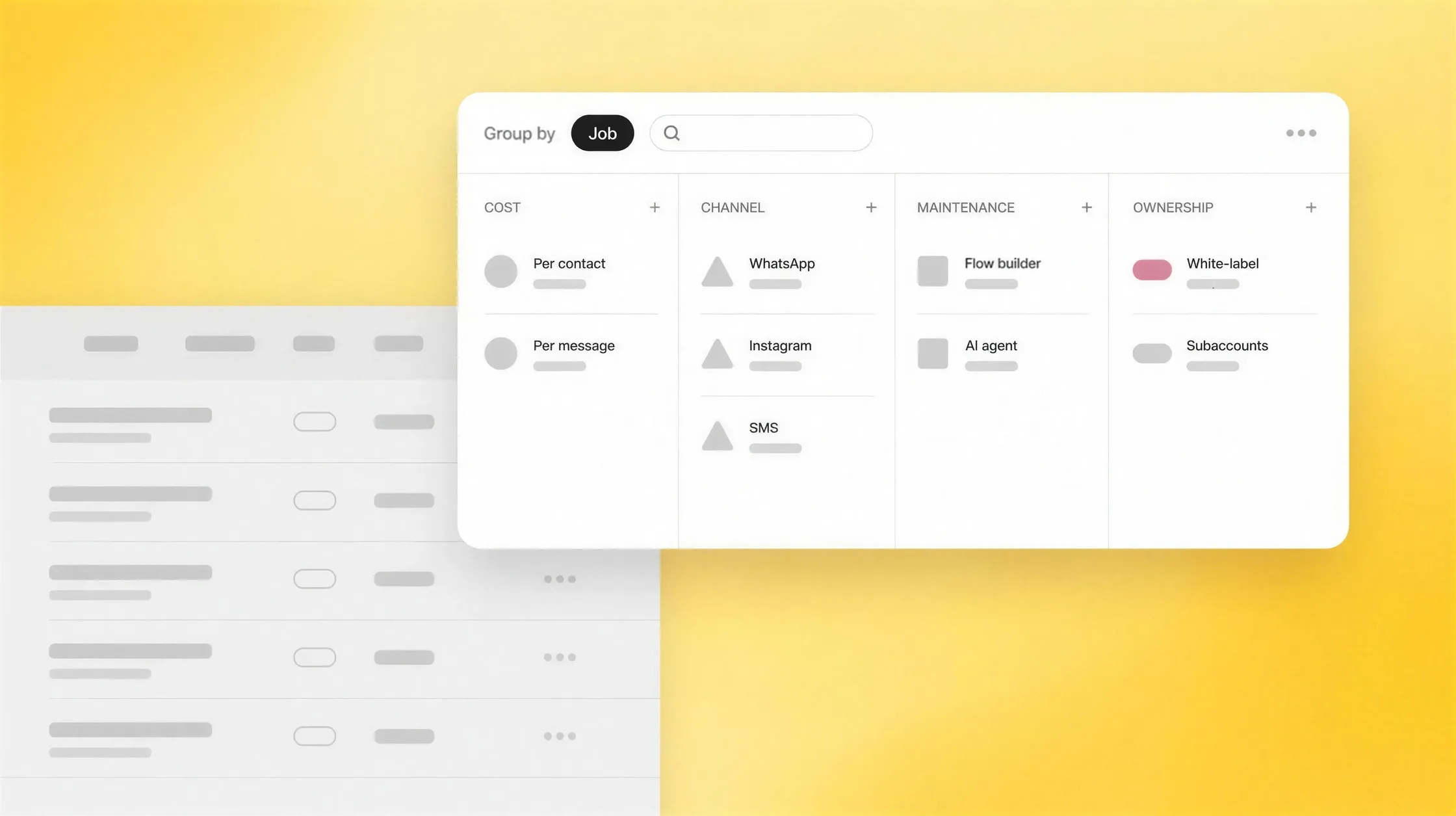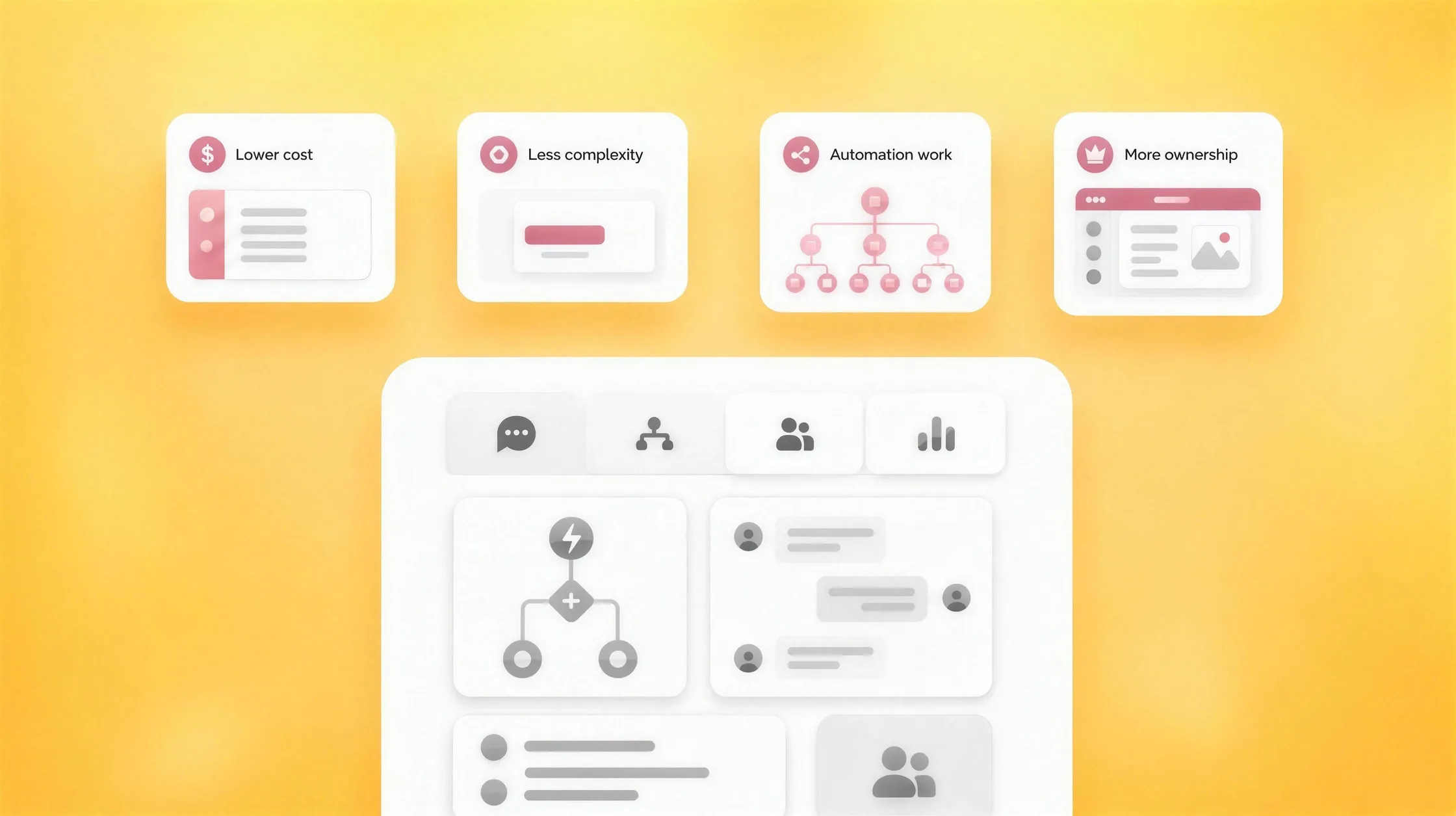
GoHighLevel bundles a CRM, funnels, email and SMS, calendars and reputation tools into one subscription, and for a lot of agencies that bundle is exactly right. When it stops being right, the replacements fall into four groups: cheaper suites, narrower single-purpose tools, dedicated automation orchestrators, and platforms built for reselling under your own brand.
Those four groups do not compete with each other. Picking well means knowing which one you are shopping in before you compare anything inside it.
The four reasons agencies shop for an alternative
Cost. The bill grows faster than the client base.
Complexity. You use a fraction of the suite and maintain all of it.
Automation limits. You hit something a trigger-and-action chain cannot express.
Branding. What your clients log into is not entirely yours.
Each of those points at a different shelf. The most common expensive mistake is switching for one reason and buying for another — shopping on cost, landing on a narrower tool, and re-buying three of the pieces you dropped within the quarter.
How the platform builds automation
This is the distinction that separates the shelves, and it is worth understanding before any price comparison.
GoHighLevel automates with workflows. You build a visual chain: an event fires a trigger, the trigger runs a sequence of actions, and conditional nodes branch the path. It does exactly what you drew, every time, and you can audit it by reading the chart.
The other mechanism is an AI agent. It reads the situation and decides what to do at runtime, which means it handles cases nobody enumerated in advance — and gives up the guarantee that it will behave identically twice.
Neither is the advanced version of the other. A workflow is the right tool for a known, repeated process: predictable, auditable, cheaper to reason about. An agent is the right tool when the input varies more than you can chart. The agencies that get burned are the ones who bought a single mechanism and applied it to every job.
A workflow executes the path you drew. An agent decides the path. Choose by how predictable your process is, not by which sounds more advanced.
If you are shopping on cost
Start with an uncomfortable number: at $97 a month, GoHighLevel’s Starter tier includes a CRM, funnels, email and SMS, calendars and reputation tools. Assembling that from separate products costs more, not less. If you genuinely use most of the suite, you are not overpaying.
The bill is only too high when you use a fraction of it — and that is a complexity problem wearing a cost problem’s clothes. Diagnose it correctly, because switching platforms to save money and then re-buying the pieces you dropped is how agencies end up paying more for less.
The one genuinely cheaper entry point in this comparison is Botpress, which has a free tier covering 100 conversations across three agents. It replaces conversational automation, not a suite. If that was the only part you were using, the gap between free and $97 is the entire decision.
If you are shopping on complexity
Narrower tools, chosen for the two or three jobs you actually do. This is the crowded shelf: ManyChat, Tidio and respond.io each cover slices of what GoHighLevel bundles, and any of them will feel lighter on day one.
Two things to check before committing. Confirm current pricing directly with each vendor — all three revised their tiers within the past year, and published comparisons go stale fast. And count the total: three narrow tools mean three subscriptions, three integrations and three vendors to manage. That is not less complexity, it is the same complexity moved from the vendor onto your operations, where you are the one maintaining it.
The rule of thumb: consolidating onto narrower tools works when you are dropping capabilities you never used. It fails when you are trying to rebuild the suite out of parts.
If you are shopping on automation limits
This shelf splits in two, and the branch matters more than the brand.
Your process is deterministic but the builder cannot express it. You know every path; GoHighLevel’s built-in builder simply cannot reach the system you need or handle the logic you want. The answer is a dedicated orchestrator — Zapier or Make. Both connect far more services and handle far longer conditional chains than any all-in-one’s native builder, and both are designed to sit alongside your other tools rather than replace them.
Your process is not deterministic. The workflow keeps breaking because you keep discovering paths nobody anticipated. Every new client question becomes another branch, and the chart grows faster than the value it delivers. No workflow builder solves that, because the problem is the mechanism itself.
That is the case agents exist for. Botpress and Voiceflow build them for general use. Stammer.ai and Lety.ai build them for agencies reselling under their own brand.
What separates those last two in practice is reach — what the agent can actually touch. Stammer.ai connects natively to channels (website embed, Instagram, Facebook Messenger, WhatsApp) and reaches everything else through Zapier or its API. Lety.ai reaches external systems directly through 900+ MCP integrations. Both arrive at the same place; one route adds a hop and a second subscription.
If you can still chart the process, you need a stronger workflow tool, not an agent. Agents earn their cost when the paths stop being chartable.
If you are shopping on branding
Every platform below advertises white-label. They mean five different things by it, and they charge very differently.
Scroll the table sideways
| Entry price | Branding starts at | What carries your brand | |
|---|---|---|---|
| Lety.ai | $97 / mo | Starter, $97 | Branding across the platform |
| Stammer.ai | $197 / mo | Agency, $197 | Dashboard and branding |
| Botpress | Free | Plus, $150 / mo annual | The chat widget only |
| Vendasta | $99 / mo minimum | Professional, $499 / mo minimum | Client portal |
| GoHighLevel | $97 / mo | $497 / mo add-on | Mobile app |
Three details the table cannot hold, and each one changes the maths.
GoHighLevel’s white-label mobile app is a separate $497 a month on top of your plan, unless you negotiate Enterprise. SaaS Mode — reselling subscriptions from your own site — arrives at Agency Pro, $497. An agency that wants both is looking at roughly $994 a month.
Vendasta’s entry tier is not white-label. It says so plainly: “Co-branding with Vendasta.” Their brand stays visible to your client. White-label begins at Professional, which is a $499 monthly minimum in wholesale product spend on a one-year contract. Price that commitment before signing, not after.
Botpress white-labels the widget, not the platform. Your client sees an unbranded chat box; they do not get a branded dashboard to log into. For an agency embedding chat on client sites that is enough. For an agency reselling a platform, it is a different product.
Where GoHighLevel is still the right choice
Three cases, and none of them are edge cases.
You need the CRM. Pipelines, contact records as the system of truth, email and SMS campaigns, calendars, reputation management, all in one place. Most alternatives here — including Lety.ai — are not CRMs and do not replace one.
Your processes are known and stable. If you can draw the chart and the chart stays accurate, a workflow builder is the correct tool. An agent would be an expensive way to get less predictability.
You want one vendor. Every alternative narrows the scope, which means more tools, more integrations, more surface to maintain. That trade is worth making deliberately.
Choosing
Work in this order and the shortlist writes itself.
Name the reason first — cost, complexity, automation limits or branding — because it decides which shelf you are shopping on. Then match the mechanism to your process: chartable means a workflow tool, and GoHighLevel or a dedicated orchestrator like Zapier or Make will serve you better than anything conversational. Not chartable means agents, and the deciding question becomes which systems they can reach and how many hops it takes to get there.
Finally, if your clients log into what you sell, ask every vendor the same question before signing: what exactly carries my brand, and what does it cost to get there? The five platforms above answer that five different ways, and the answer is rarely on the pricing page without an asterisk.
For agencies whose reason is branding and whose processes have outgrown a fixed chart, that is the gap Lety.ai was built for: AI agents that integrate with the tools you already run, under your own brand from the entry plan. Over 1,000+ agencies build on it, with 2,000+ AI agents deployed under their names rather than ours. The starting points are the white-label platform and the reseller program.
Pricing and branding terms verified against each vendor’s own pricing page on 22 August 2026. These platforms revise tiers often — confirm current terms before committing.