Much of what you will read about the WhatsApp Business API is out of date. Meta changed how it charges in July 2025 and shut the previous version down entirely in October of the same year. This article describes how it works today.
What the WhatsApp Business API is
It is the route by which a program — not a person — sends and receives WhatsApp messages on behalf of a business.
The most important difference is that it has no screen. There is no inbox to type in and no dashboard to watch conversations on. It is a connection: your business has a system on one side, WhatsApp sits on the other, and the API joins them so messages travel between the two on their own.
Understanding that avoids the most common confusion. The API does not hand you a chatbot or a support tool. It hands you the channel. What people see, what answers them, and what decides the reply all come from another program layered on top.
Today that connection lives on Meta’s servers. The previous version, called On-Premises, was installed on a company’s own servers and is now switched off: Meta stopped accepting new numbers there on 1 July 2024, and the last supported version expired on 23 October 2025. Messages sent that way are no longer delivered.
This is worth stating plainly, because most of the third-party documentation still circulating describes that obsolete architecture, with your own servers and security certificates to administer. None of it applies. The current version is hosted by Meta, which in its own words removes the “installation, hosting and maintenance” overhead.
If a provider asks you to stand up servers to connect WhatsApp, they are describing an architecture Meta shut down in October 2025.
API versus app: which one your business needs
These are two different products, not two plans of the same one.
WhatsApp Business, the application, is downloaded, operated by hand from a phone, and built for answering conversations one at a time. It is enough when one person can handle the volume and you do not need to connect the channel to anything else.
The API is not operated by hand. It exists so another system can do the work: answering automatically, querying your database, booking on your calendar, alerting a customer when an order changes. It is the only route if you want the channel to talk to the rest of your tools.
The useful question is not which one is better. It is this: is the value in what gets answered, or in what happens after the answer? If answering is enough, the app does the job. If answering has to change something in another system, you need the API.
What it actually costs
Here is the change that invalidated almost everything published before it: since 1 July 2025 Meta charges per message, not per conversation. The old scheme billed 24-hour conversation windows. It no longer does.
Charging works like this today:
- You are charged when a template message is delivered. Not when you send it — when it arrives.
- Marketing: always charged.
- Utility and authentication: free inside an open service window, charged outside it.
- Messages that are not templates: free inside the service window.
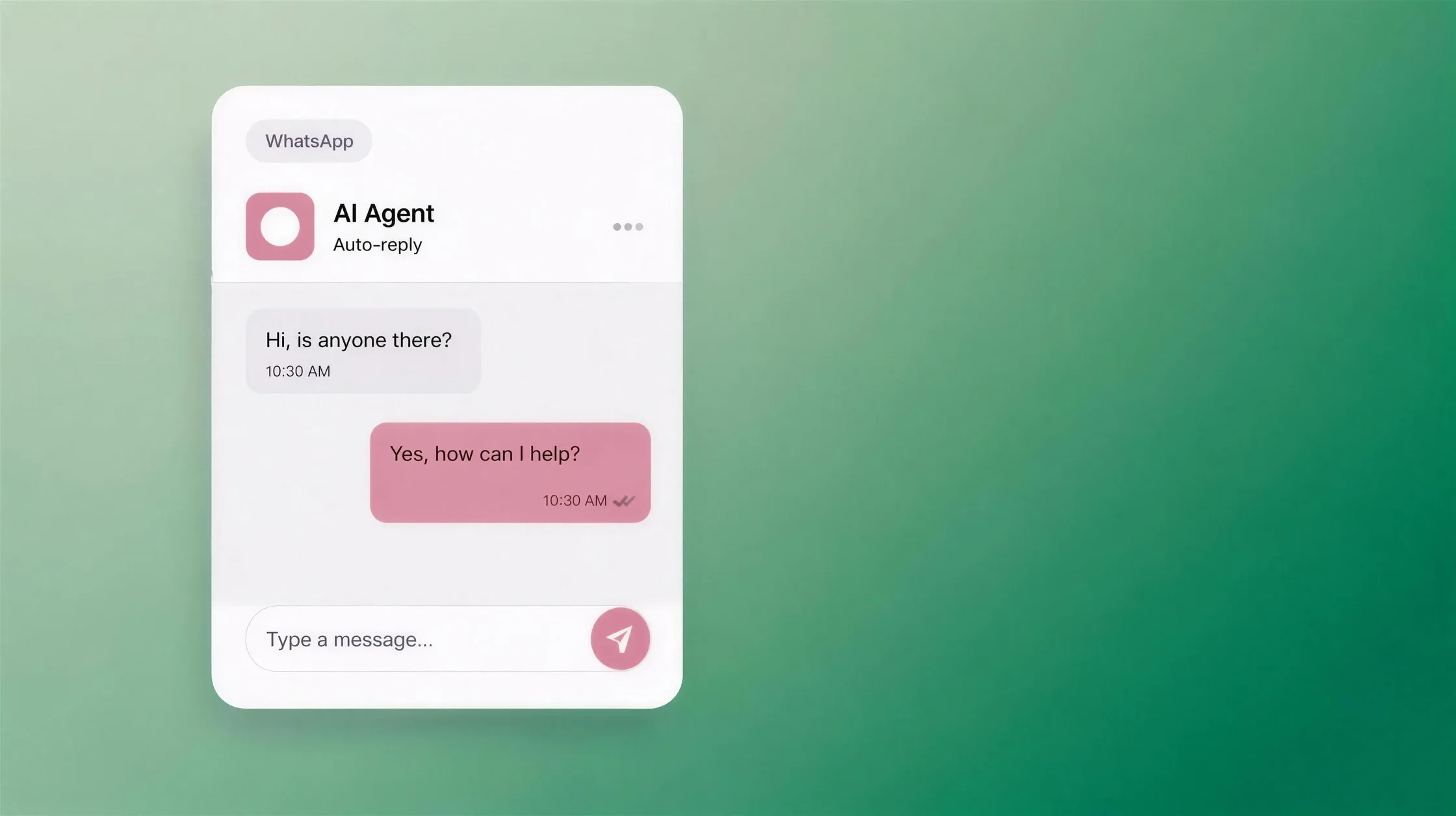
The customer service window still exists, but its job has changed. It used to define the billing unit; now it defines what you are allowed to send and what comes free. It opens when a customer writes to you and lasts 24 hours. Inside it, you reply freely at no cost. Outside it, you can only open with a template, and that template is charged.
Meta adds one exception: when a conversation starts from a click-to-WhatsApp ad or a button on a Facebook page, every message is free for 72 hours, templates included.
There are also volume discounts on utility and authentication templates, calculated across your whole business portfolio and reset every month.
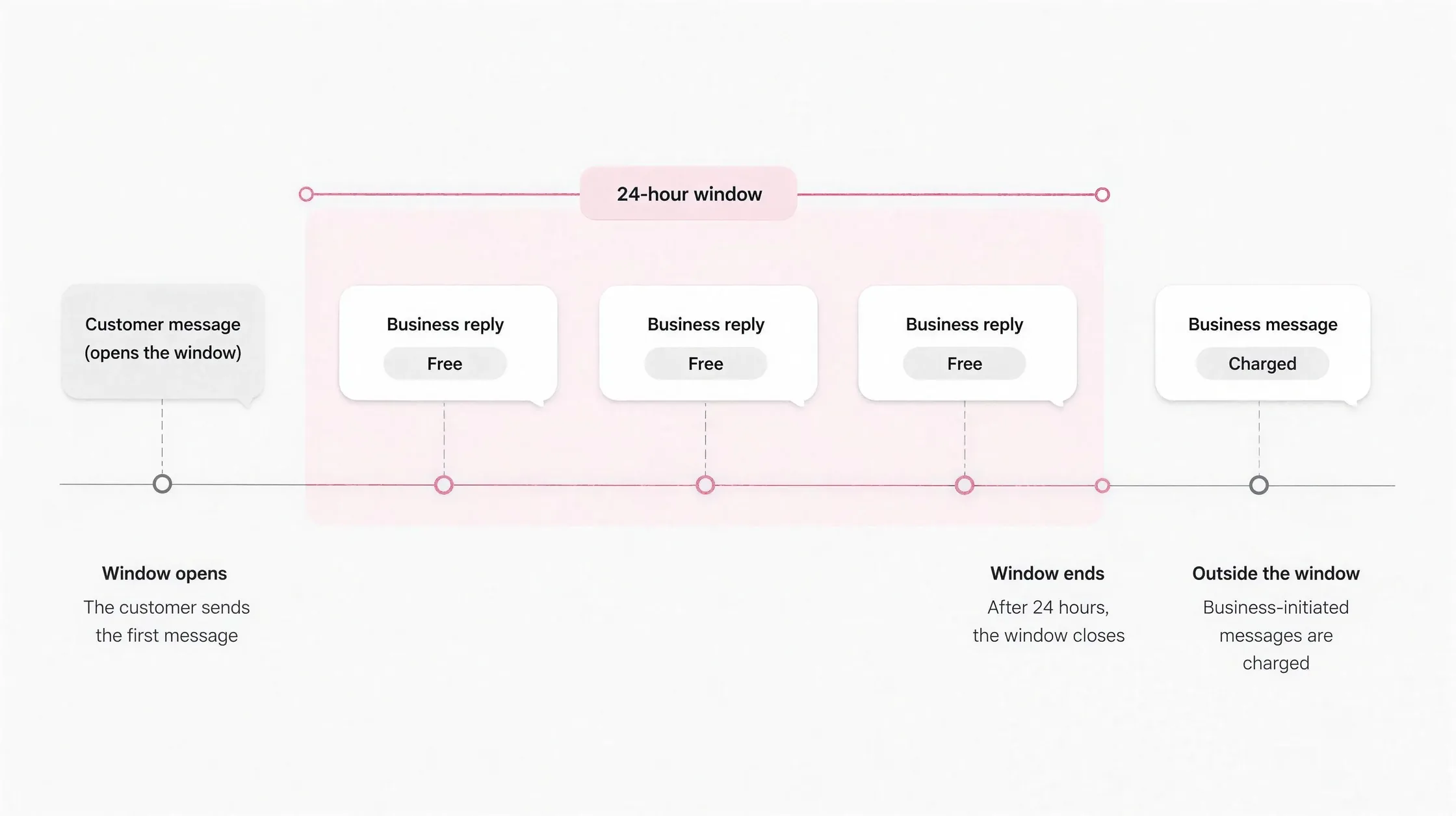
Inside the 24-hour window the customer opens, replying costs nothing. Opening outside it requires a template, and that template is charged.
Replying is free. Opening costs money. The whole of cost design comes down to getting the customer to open the conversation.
What about the free version?
It is the most searched question here, and the answer has two parts.
Meta does not charge for access to the API. There is no licence and no monthly platform fee. What you pay for are messages, with the exceptions above.
What does cost money is everything else: the software that connects to the channel and, if you go through a provider, whatever that provider charges on top. A business that only replies inside the 24-hour window can have a message bill close to zero and still be paying for the tool that does the replying.
Providers: what they are and when you need one
There is a category of companies authorised by Meta that resell and wrap the access. The documentation calls them Solution Partners and Tech Providers; the industry calls them BSPs.
They are not mandatory. Meta says so explicitly: a company building for its own use can go direct. That is the clarification that saves the most money, because a good part of the market presents the middleman as a requirement.
What they add is real, but bounded:
- Solution Partners offer a credit line — the customer skips the payment setup — and bill platform usage themselves.
- Tech Providers supply the software layer, but the customer brings their own payment method and Meta bills them directly.
- Both add support, integration and billing.
It helps to separate two decisions that usually get mixed together: who gives you the access and what software runs the channel once you have it. The same company does not always cover both. Lety.ai is the second one: the layer where the agent that answers is built and administered.
The test for the first decision is simple. If you have someone who can code and you want control and direct cost, go straight to Meta. If you need someone to handle the setup, the integration and the support, a provider makes sense, and their margin is the price of that.
Requirements and how to get access
Much lighter than it is usually made out to be, precisely because there is no longer a server of your own.
- A Facebook account or a managed Meta account.
- Developer registration on Meta’s platform.
- A WhatsApp Business account, existing or new.
- A device with WhatsApp to send and receive test messages.
- Someone to code the connection: you have to prepare the endpoint where your system receives incoming messages and write the calls that send outgoing ones.
That last point is the real filter. It does not take infrastructure, it takes development capacity — or a product that has already solved it for you. Production adds business verification and number configuration steps that are not part of getting started.
What an agent automates on top of the API
The API delivers the channel. An agent is what decides what to answer and what to do, and that is where the cost of the channel either turns into return or turns into nothing.
On WhatsApp the patterns that work are the same as on any channel, with one important difference in framing: because replying inside the window is free and opening is charged, it pays to automate the reply before the send. Answering common questions, qualifying whoever writes in, booking, reporting order status and following up all happen inside the window the customer opened.
It is the economic angle almost nobody mentions: automating the reply does not just save time, it saves invoice.
For an agent to do more than answer text it has to reach your systems: calendar, CRM, catalogue. At Lety.ai that layer is 900+ MCP integrations, and it is what decides whether the agent can resolve the query or merely talk about it.
Where to start
Start by measuring, not by integrating. For one week, note what people ask you on WhatsApp and how many of those conversations the customer opens. If the customer opens most of them, your message bill will be low and the work is in answering better. If you have to open them, the cost will sit in templates and they are worth designing before you connect anything.
Then decide the route: direct if you have a technical team, through a provider if you do not. And only then choose the software that will run the channel.
If you are on the other side of the counter — you want to build these agents and sell them to businesses like the one just described — that is a different job with a different economy. It is what the 1,000+ agencies building on Lety.ai do, with 2,000+ AI agents deployed under their own brand. You can start with the white-label platform or with selling AI agents.
Pricing, template categories and shutdown dates verified against Meta’s WhatsApp Business Platform documentation in September 2026. Meta revises this scheme often: confirm current rates before projecting costs.